
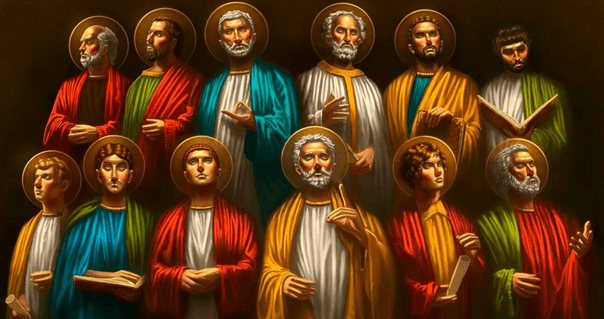
The Role of the Apostles.

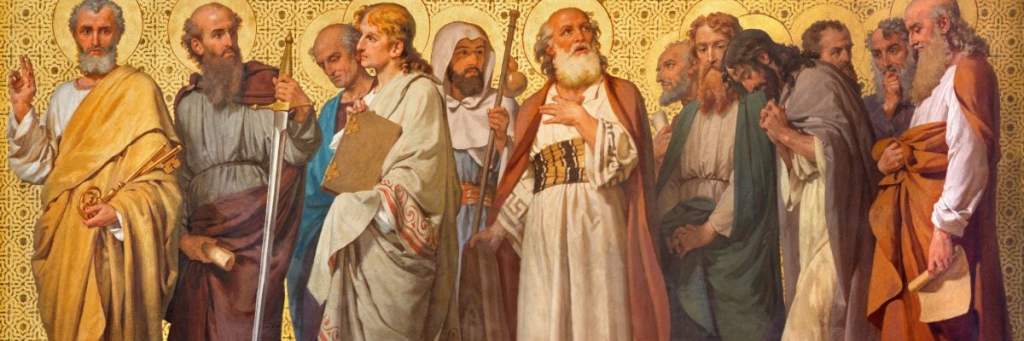
Roman Catholics claim the Papacy is an institution begun by Christ as recorded in Matthew 16:13-19. In this passage, Jesus is asking His disciples who they think He is. As Jesus gained notoriety, rumours swirled because of His miracles, exorcisms and the authority of His sermons. Some thought He was the prophet Elijah reborn, others a re-incarnation of the recently beheaded John the Baptist. Peter sprung up and exclaimed correctly that Jesus was “The Christ, the Son of the Living God” (Matt 16:16). Jesus’ answer to Peter’s declaration is a primary point of contention between the Roman Catholic Church (RCC) and the rest of Christendom. Jesus replies to Peter by saying:
“17 And Jesus said to him, “Blessed are you, Simon Barjona, because flesh and blood did not reveal this to you, but My Father who is in heaven.
18 I also say to you that you are Peter, and upon this rock I will build My church; and the gates of Hades will not overpower it. “
“You see,” say the Catholics “Jesus said He would build His church on Peter, because the name Peter means ‘rock.’ It states it right there.”
I would disagree with this interpretation of the sentence but let’s look carefully at the Greek wording to see if we’ve missed something. Peter’s original name was Simon Barjona but Christ gave him the name Peter (Petros in the greek). Peter or Petros — means “a rock or a stone” that is bigger than a lithos. A lithos is a stone small enough to be thrown or carried. Then Jesus states that He will build His church on the petra, which, in the Greek, means a large projection of stone such as a cliff ledge or a boulder. It can also mean a crag in a mountain side or a ground littered with many rocks. In the New Testament, the term Petros only appears in reference to Peter which makes it likely it was a nickname based on the word petra — not unlike calling someone who is tough “Rocky.” According to Thayer’s Greek Lexicon, the word petra signifies a massive rock and the word petros means a piece of that large rock. As for the usage of the word petra in the New Testament, it is used exclusively for large rock formations. Some examples are:
- The large foundation of rock upon which you could build a house. Matthew 7:24
- During Crucifixion, the large rock hills around Jerusalem were split due to the earthquake. Matthew 27:51
- The large “stumbling rock” prophesied by Isaiah when both Paul and Peter tells us this was Christ Himself. Romans 9:33, 1 Peter 2:8
- Paul compares Christ to the large rock that Moses struck in the desert and from which flowed water in the desert. 1 Corinthians 10:4
- When facing Judgment from the Lamb of God, men will call out for large rocks to fall on them from the mountains so that they can avoid facing God. Revelation 6:15-16
A straight forward understanding of Christ’s intent in this phrase is to say “you are a piece of the rock, and upon this large foundation of rock I will build My church.” The large rock in question is in fact Jesus the Messiah, which Peter had just prophetically recognized. This interpretation of Matthew 16 is consistent with passages in both the New and Old Testament which state that the coming Messiah is the cornerstone of God’s plan for humanity’s salvation.

The main point in Matthew 16:13-19 is not Peter but the Messianic identity of Jesus. And the claim that Jesus would build His church on a human being goes against the gospel. Paul in Ephesians 2:20 concludes that “Jesus Christ Himself [is] the chief cornerstone” of the church. Psalm 118:22-23 declares that the “stone which the builders rejected has become the chief cornerstone.” In 1 Corinthians 3:11 we are plainly told that “no other foundation can anyone lay than that which is laid, which is Jesus Christ.” No other massive rock (petra) will uphold the church. Not even Peter, the piece of rock or “Rocky”(petros).
Now, the RCC will claim headship of the church for Peter. His role as one of the three chief apostles alongside James and John is likely. His role as the head of the worldwide church is contested. James, Jesus’ earthly brother was head of the church in Jerusalem. Paul, the converted Pharisee, provides us with the majority of the New Testament letters and was the chief missionary spreading Christianity throughout the world. During a meeting between Jewish and Gentile Christians in Antioch, Paul publicly rebuked Peter when the latter refused to eat with the Gentiles in violation of Christ’s direct commands to him in Acts 10:27-29. Peter humbly took the rebuke. Whatever hierarchical role Peter had in the original, apostolic era church, he was not beyond reproach and he was neither the chief theologian or missionary.
“You forget one thing,” my catholic friends will say, “verse 19.”
19 I will give you the keys of the kingdom of heaven; whatever you bind on earth will be bound in heaven, and whatever you loose on earth will be loosed in heaven.”
18th century British theologian John Gill clarifies that the “keys of it are abilities to open and explain the Gospel truths,” and that the power to bind and loose refer not to choosing what are or are not sins (this in the Law of Moses and Jesus said none of it could be altered) but “only of doctrines, or declarations of what is lawful.” Outside of the four gospels it was the writings of the apostles that formed the theological doctrines and church government statutes of the church. Peter only provided two of the 21 New Testament letters and Paul produced the lion’s share with his thirteen epistles. Over the centuries, the RCC developed a view of Peter as being empowered to deliver new revelations from God on par with the Scriptures themselves. In 1870 this was codified by Pope Pius IX and called “ex cathedra” meaning “from the chair of St. Peter.” In essence, the RCC claimed that Peter’s role as the first Bishop of Rome (not taught in the New Testament) was to begin a succession of worldwide church leaders called Popes that would be given the keys of Matthew 16:19 and thus endowed with the ability to deliver a continued series of inspired teachings.
The rest of Christendom has traditionally rejected the notion of a supreme, sometimes even infallible worldwide human head of Christ’s church. They point to the fact that even the apostles never taught anything in their New Testament letters that was not already declared either by the teachings of Christ in the four gospels or the Mosaic Law of the Old Testament. They merely re-inforce Christ and Moses’ teachings.
To believe Christ gave a never ending line of popes the power to speak new teachings is to read too much into a single verse. Only with revisionist, Catholic glasses do we see an over-emphasis on Peter and his supposed successors as having superhuman divine empowerment.
In Part 4 we will cover the very first time someone attempted to create a Christian denomination and how it was immediately shut down.




 What Christians Believe