
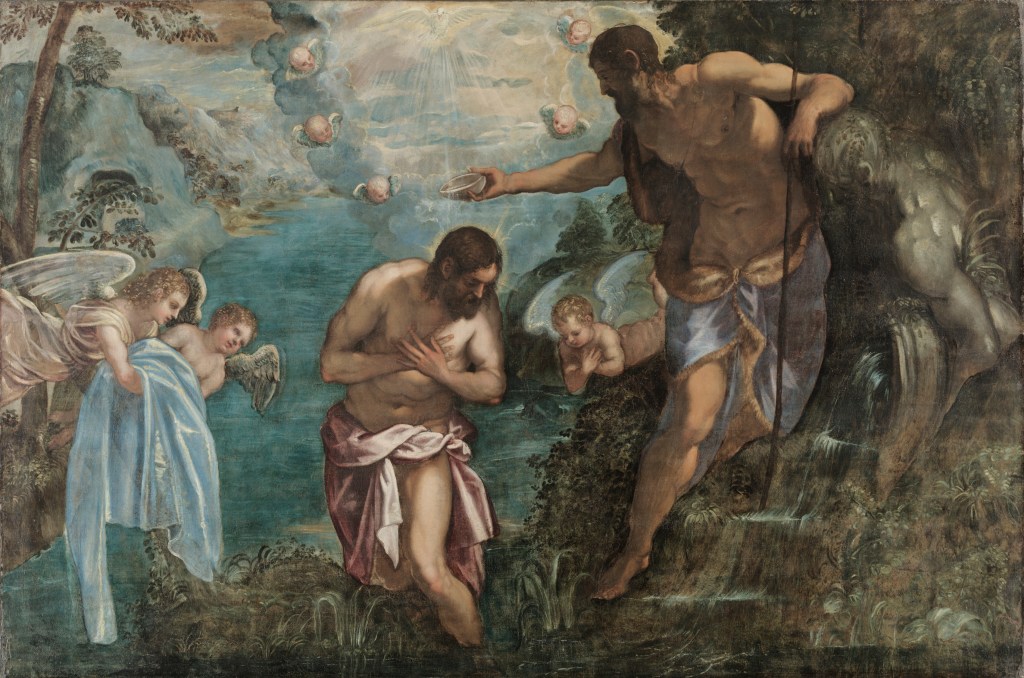
Baptism in the Early Church
Matthew’s gospel introduces us to John the Baptist. And to baptism. How was it practiced by the apostles and their students in the earliest years of Christendom? Are there any differences among Christian denominations when it comes to this Sacrament? What is the reason Christ asked us to perform it? Catholics, Orthodox and Reformed Christians all practice it without exception. It is a universally recognized Sacrament that has lead every generation of Christ’s disciples into the waters of baptism.
Baptism in the Old Testament
Christian theologians see the New Testament as the climactic finish of the Old Testament as well as the only fully inspired and inerrant commentary on it. The bible is a single work in the eyes of Christians. Not the janky patching of two religions forced together with duct tape. It is a continuous whole. In 1 Peter 3:20-21 we are told that Noah’s Flood was a “type of baptism” showing God’s desire and power to snuff out every ounce of evil from the human race. This first world wide apocalypse was the death of all sinful flesh that walked the earth. To Peter it was qualitatively the same as the believer’s baptism. The death of the flesh in a mock burial. A mock Noahic Flood for the individual.
Writing to the Corinthian church Paul reminds them that when Moses lead Israel through the waters of the Red Sea — leaving bondage and entering into freedom — Moses was baptizing them into new life (1 Cor. 10:1-2). Other theologians have pointed to Joshua and Israel crossing the Jordan as being a mini re-enactment of this Red Sea Crossing.
And let us not forget the ritual cleansing dictates given to the Levitical priesthood. After ordination and prior to their first act of service, priestly Levites were cleansed with water from head to toe (Exodus 29:4; Leviticus 8:6). If they committed acts that lead to impurity they were fully immersed in waters before being fit to continue in service (Leviticus 15; Numbers 19:7–10). Each year, before entering the Holy of Hollies, the High Priest bathed himself twice (Leviticus 16:4, 24).
God foreshadowed the Messianic (a.k.a. New) Covenant when He told Ezekiel that He would:
“sprinkle clean water on you, and you shall be clean from all your uncleanness… …I will put my Spirit within you, and cause you to walk in my statutes and be careful to obey my rules”
– Ezekiel 36:25-27
The sacred waters of baptism are not a New Testament novelty but the climax of a long-developing pattern
Baptism in the New Testament
By the third chapter of Matthew — the very first book of the New Testament — baptism is no longer foreshadowed; it is happening. At the end this gospel, right before the Ascension, Christ commands His followers to “make disciples of all nations, baptizing them in the name of the Father and the Son and of the Holy Spirit” (Matt. 28:19). In the book of Acts, the apostles command their audience to “repent and be baptized.” In almost every instance we see the qualifier “for the forgiveness of your sins” or to “wash away your sins.” There appears to be a sense of immediacy. Even a near urgency. As was the case with Phillip and the freshly converted eunuch.
Scripture is the highest authority (sola scriptura) when it comes to the records of God’s doctrinal and historical teachings. And it tells us that Christ promised the Church age would be left without His physical body but with the Presence of God the Holy Spirit. That this Spirit would guide the Church until His Second Coming. For this reason, when every generation of church leaders unanimously agree on a matter that fits with — or at least does not contradict — the Scriptures, I pay attention. In all of the first 16 centuries of the Church it was unanimously proclaimed that the Sacrament of Baptism was not merely symbolic but was a holy ceremony in which God honoured His promise to give the believer forgiveness of sins and the indwelling of the Holy Spirit. All of the original reformers (e.g.: Luther, Calvin, late Zwingli) also believed this to be the case.
The church fathers and their successors acknowledged that it was a believer’s faith that made the Sacrament of Baptism a channel of grace for God. The mere act of entering the baptismal waters was powerless without a converted heart and the power of the Holy Spirit:
“For it is not mere water which washes the soul, but it is itself first purified by the Spirit that it may wash souls.”
- Tertullian “Treatise on Baptism” – early 200s AD
“For water alone is not able to cleanse away sins and to sanctify a man, unless he have also the Holy Spirit.”
- Cyprian of Carthage “Epistle 73/74” – mid 200s AD
Consensus among the church fathers was that Simon the Sorcerer (Acts 8) was baptized but unconverted and unregenerate. Church history states that he even became the founder of a heresy that grew into the Gnostic sect the church had to contend with for centuries. On the other hand the thief to Christ’s right is unanimously declared as unbaptized but converted. The Church has always believed that there is such a thing as the “baptism of blood and desire.” Meaning that if someone converts and intends on being baptized but somehow dies before this act of obedience can be fulfilled, they are not damned. In fact, Hippolytus of Rome’s “Apostolic Tradition” written in the early 200s AD lists the church in Rome’s protocol with new converts. Surprisingly, instead of the sense of urgency seen in the book of Acts, Roman churches put their new professing converts in a 2 to 3 year probation period in which they were closely observed to ensure proper conversion before they were eligible for baptism and communion. Yet the church did not feel this soon-to-be baptismal candidate would be damned if they died pre-baptism.
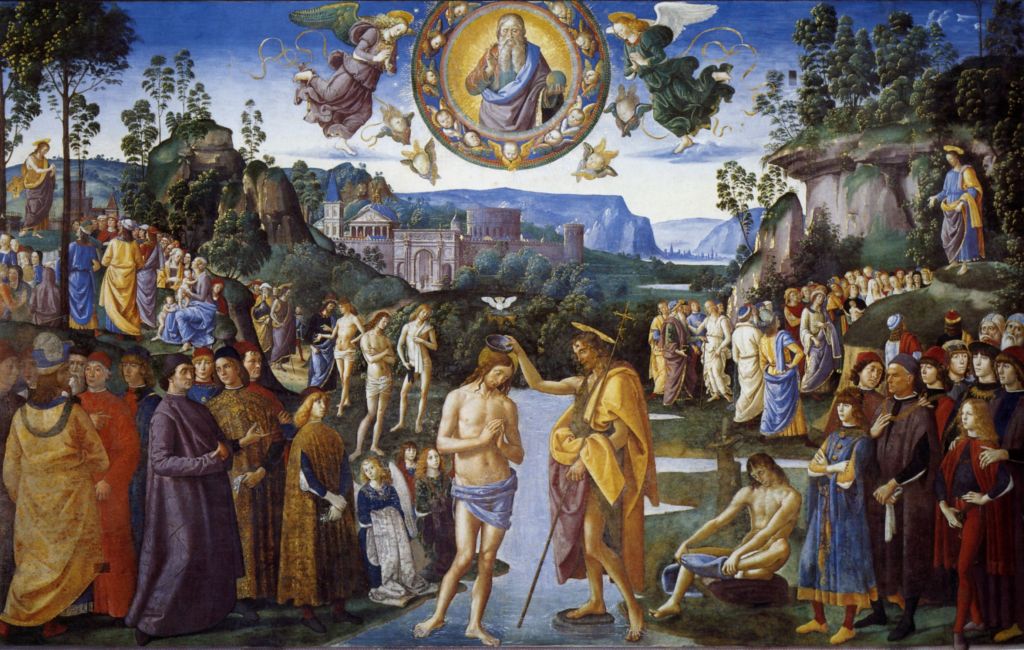
Christ’s Pronouncement on Baptism
Not only did Christ command baptism be done to every disciple, He Himself entered the baptismal waters. Christ was sinless and His baptism was more of an ordination as High Priest, in the fashion of the newly ordained Levitical priests (Exodus 29:4).
When Nicodemus approached Jesus he was told that:
“unless one is born of water and the Spirit, he cannot enter the kingdom of God.”
– John 3:5
For decades I thought this meant “unless one is born physically and spiritually, you can’t go to Heaven.” The reason for my belief was the structure of the passages before and after verse 5.
Verse 3:
“unless one is born again” —> born physically, born a second time
Verse 4:
Nicodemus asks if Jesus wants him to re-enter his mother’s womb —> born physically, born a second time
After Verse 5 we have Verse 6:
“that which is born of the flesh is flesh, and that which is born of the Spirit is spirit.” —> born physically, born a second time (spiritually)
Hebrew parallelism is a technique found in the Old Testament in which a concept is repeated, with slight variations, in order to highlight the importance of a teaching. I felt that verse 5 was best explained as a continuation of the two births being described from verses 3 through 6. I saw verse 5 as the third of the four consecutive verses on the two births. I felt this was a logically consistent hermeneutic. Especially since I was told that in the ancient world, the word “water” was used to mean the amniotic fluid discharged during birth. However I could not find any ancient gynecological studies or general writings that used the terms “water” or “born of water” to describe pregnancy and child birth. The closest we have in the earliest Greek, Roman, Syrian or Jewish studies of human nature are words like “moisture” or “fluids” to signify human reproduction, pregnancy and physical birth.
From the second century all the way to the Reformation — including the Reformers themselves — there is unanimous belief that Christ is speaking of baptismal waters in verse 5. It is daunting to think the Holy Spirit would allow instant and permanent error about something as crucial as baptism to go unchecked for all of church history.
Before the Ascension, Christ left a daunting, universal mission command to His followers:
“Go therefore and make disciples of all nations, baptizing them in the name of the Father and of the Son and of the Holy Spirit, teaching them to observe all that I have commanded you…”
– Matthew 28:19-20
Making disciples involved baptizing them. As we see in the book of Acts. Does the ritual of baptism involve symbolism? Of course. But it is also a Sacrament. Something occurs in the supernatural when a convert enters the baptismal waters in an act of obedience to God. It is high time we return to the classical understanding of the Scriptures and re-capture the mysteries of God. In the western world, many Reformed Christian networks have slowly absorbed the modern materialist culture that surrounds them. The rituals left to us by Christ have become somewhat casual and symbolic. Like the pledge of allegiance or the sign of the cross. However, throughout history, Christians transcended this mundane, earthly life in part by engaging in the mysteries of the Sacraments. If this appears as superstitious to you, you are the product of a recent development in Christendom and stand apart from the masses of fellow believers lining up throughout the past millennia. We need to recapture the awe of worship in Sacramental practice.
Infant Baptism
Here I remain conflicted. Having been born into a catholic part of the world, I myself was infant baptized. Later, in my early twenties, I was publicly baptized by submersion in a protestant setting. When I read the biblical accounts they present baptism as the response of faith—credo-baptism. Someone comes to Faith — the Creed — and then is baptized. It is the normative example throughout the New Testament. However, from the beginning of the third century onwards, only one voice (Tertullian) expressed doubts on infant baptism. Not absolute resistance, just doubt. The rest of church history shows leadership either not mentioning it or being in explicit agreement with it. Origen (~240s AD) even says it was a tradition passed down by the Apostles themselves. Even the first generation of Reformers practiced it. It is only since the 16th century rise of the Anabaptists that we see any full throated denial of its validity. Martin Luther fought in favour of infant baptism and even in our modern era we see half of the twelve major protestant branches still practicing it. It has been the overwhelming majority of Christendom today and throughout history that have embraced it.
Now, I believe no church history can trump Scripture. Therefore, as daunting as the Church’s acceptance of it is, I still needed to see if it was congruent with the New Testament. No explicit infant baptisms appear in the bible. Standard practice is sentient believers professing and THEN entering the waters. However we see instances in which households are baptized together after the head of the home entered the faith.
“And after she was baptized, and her household as well,”
– Acts 16:1 (Lydia)
“And he brought them out and said, ‘Sirs, what must I do to be saved?’
And they said, ‘Believe in the Lord Jesus, and you will be saved, you and your household.’
…And they spoke the word of the Lord to him and to all who were in his house.
…And he was baptized at once, he and all his family.”
– Acts 16:30-34 (Philippian jailer)
Two other instances in the New Testament speak of households or families being baptized together. In Greek oikos (οἶκος) is used for household and means anyone living in a residence. Included are in-laws, servants and immediate family. No one in any branch of Christendom believes a child or a parent is automatically saved because the head of the household comes to faith. God deals with individuals. So what did it mean for the Philippian jailer’s belief to save his entire family (Acts 16:31)? It could potentially mean that his faith put his household in a position of covenant alignment and blessing the way a nation is blessed when its leadership turns to God. When Jonah’s preaching convicted the king of Nineveh, he issued a proclamation of national repentance and the Lord God lifted His Wrath from them (Jonah 3:6-10). But, because of verse 32:
Acts 16:32 And they spoke the word of the Lord to him and to all who were in his house.
It could also mean that the household believed and then was baptized. And now, if we infer from this that Lydia’s household and all other household baptisms were preceded by preaching and acceptance, we are back to seeing household baptisms as following conversion and therefore not necessarily including infants.
“So, do we have ANY EVIDENCE from SCRIPTURE that the apostles baptized infants?”
In 1 Corinthians 1:16 Paul recounts baptizing the “household of Stephanas” and in Acts Paul and Silas baptized whole families. Surely there could have been infants?
Absolutely.
Now, in hermeneutics (principles of understanding texts’ original intention) there is a clause known as synecdoche. It is a rhetorical principle in which we use language encapsulating a whole group when we actually mean either its leadership, its majority or a significant portion thereof:
“O’ Jerusalem, Jerusalem, the city that kills the prophets and stones those who are sent to it!” (Jesus in Matt. 23:37)
“And the people of Israel did what was evil in the sight of the LORD and served the Baals.” (Jud. 2:11-12)
“But the Pharisees said, ‘He casts out demons by the prince of demons.” (Matt. 9:34)
We know that not 100% of the members in the above groups were included even though the language seems to say so. This is synecdoche.
Now, as uncomfortable as it makes my credo-baptist views, I have to admit that at least the majority of the families, servants and in-laws were baptized. Some of those would have been young children and servants. Did they come to a personal belief as well?
Maybe. Maybe not. I can’t completely shut the door on this point.
But the notion of applying a covenant action to a whole group is done throughout the bible (e.g.: circumcision and Passover observances). And the language in these verses appears to allow an open door for this to be the case with baptism. What are the chances that all or even the majority of a household believed right away just because its leader did? Certainly not 100%. It is like when a father makes a household decision that the family will eat healthy. He has the authority to force the decision on the rest and they follow regardless of their enthusiasm.
Circumcision
Hebrew infants were circumcised to set them apart as descendants of Abraham. Adult converts to the Mosaic Covenant were subsequently circumcised. It served as both a national passport and a religious declaration. It was us signing our end of the contract with God.
“In him also you were circumcised with a circumcision made without hands, by putting off the body of the flesh, by the circumcision of Christ, having been buried with him in baptism”
– Colossians 2:11-12
The LORD did not ask the Hebrews to wait until maturity and make a conscious decision. A Hebrew child could grow up — like Esau did — and reject the LORD. His circumcision would mean nothing. But Jacob did not entertain getting circumcised again, by choice, as an adult. His free will decision to remain obedient validated his infant circumcision. Esau’s unrepentance invalidated his. Could baptism be a Messianic Covenant that replaces the Abrahamic one? Let’s examine.
Just because circumcision is used as an Old Testament symbol for a New Covenant sacrament does not mean it is purely its equivalent. For example, the animal sacrifices in the Old Testament were a symbol of Christ’s Crucifixion but not its equivalent:
“It is impossible for the blood of bulls and goats to take away sins.”
– Hebrews 10:4
The entire sacrificial system and Levitical priesthood was a shadow of the True High Priest and Sacrifice to come: Jesus Christ, the Son of God. There is no comparison between the two. If we look at the Old Testament’s view of circumcision, we will see that it stood as a symbol — even then — of obedience to and trust in God:
“Circumcise therefore the foreskin of your heart, and be no longer stubborn.” – Deuteronomy 10:16
“…if then their uncircumcised heart is humbled…” – Leviticus 26:41
In these and other verses, it is Israel who is scolded for being physically but not spiritually circumcised. So could it not be that the symbol of circumcision meant personal obedience and that it had no stand alone sacramental power? Yes. Were there national, economic and civic reasons for God asking the Hebrews to be identified via physical circumcision? Of course.
However, the same way the slaughtered spotless lambs only symbolized the actual Atonement, the act of circumcision had no power to replace personal faithfulness or obedience to God’s decrees. So I do not see baptism as a simple continuation of the act of circumcision but as the true fulfillment of what physical circumcision represented.
Infant baptism proponents point out that the first free will converts in Christian history were sentient, independent adults and this could be the reason we only hear of adult baptisms in the Gospels and in Acts. Abraham was the first biblical circumcision and he was in his later years. Yet it was meant for infants from then on.
Again, the notion of infant baptism violates my decades long beliefs and biases. But all the original Reformers practiced it and all five of the Reformed Confessions — from 1530 AD Augsburg Confession to the 1646 AD Westminster Confession — affirmed this practice.
If we are informed by history, we see the standard practice of baptism involving infants. Like it or not. And I certainly don’t. But I have to accept it academically.
IN CONCLUSION
Baptism is a Sacrament. Not merely a symbol.
God is not bound to any ritual or Sacrament and can, will and does extend His Mercy to those who accept His Son and have not been baptized.
Not even Catholics believe unbaptized infants are damned. The Orthodox and Reformed certainly don’t.
It appears legitimate that baptism can be applied to infants whose lives will then go on to either validate or invalidate this Sacrament. Much like we would say of newly baptized adults. We watch to see if their lives match their confession, at which point we do not ask them to be re-baptized even as they hit higher levels of sanctification and spiritual maturity.
Should we withhold adults who choose to be baptized in later life, even if they were infant baptized? By no means. I did exactly that. And have never regretted it.
I remain far more comfortable with credo-baptism but I am willing to admit that I am in the minority throughout the history of the Church’s leaders and laity. I do not hold church history or ecumenical councils as highly as I elevate Scripture — unlike my Catholic and Orthodox brothers and sisters — but I find it difficult to believe the Holy Spirit, the Church’s Helper, would be so incredibly silent on a central doctrine throughout all of history.
________________________________




 What Christians Believe